Wednesday, June 16, 2010


(don't know your flags? time to start learning! click on each flag for some general info about each country)


First things first... World Geography: What do we Already Know?

We hear about the soccer teams of each of the 32 countries competing in South Africa, but how much do we really know about the countries themselves? Each nation has a unique story- not just for their soccer team- but in the country they represent. Just look at the political representation- republics, monarchies, and even single party communist states, are all present in South Africa. Different languages, accents ideologies, and ethnicities all come together in one place.

Let's take a quick quiz- assessing what we already know. Try your hand a
t locating the nations competing in this year's World Cup. Don't play too much though- you can do that later.


Travel IQ World Cup:


The Traveler IQ challenge ranks geographic knowledge of cities such as: Honolulu, Puebla or Savannah by comparing results against 5,631,262 other travelers. Brought to you by TravelPod, part of the TripAdvisor Media Network


Or try ESPN Map Madness World Cup:

Some Background Information

Take a look at some links that will help provide information about both the World Cup itself, and the countries involved. You can get a quick view of some relevant information by clicking on the flags above, where FIFA (the international football organization) has basic provided country data about each World Cup team, including general geographic info, population data, mottos, and team performance histories.

FIFA (Federation Internationale de Football Association)- homepage of soccer's international governing body, with a good overview of the 2010 World Cup tournament

Fox Soccer- interactive map of countries involved; chose a country and click "Country Facts"

32 Teams, 1 Dream- ESPN vignettes about each team and its history

CIA World Factbook- reference for basic data on every world country; check out meanings behind flags ("Flages of the World"); directly compare data from different nations ("Country Comparisons")

World Maps
- click around to find a collection of various types of maps, including thematic maps such as language, religion, literacy, and po
pulation


Watch this CNN video
, which does describes the interesting relationship of the tournament and its meaning to some of the people of South Africa.


Now take a look at some of the advertising for the World Cup- think about what types of attitudes and messages are portrayed and stressed- politically and culturally? Do you think they are effective? What about accurate, or appropriate? Who is represented, and how are they represented? Do you buy into any of these messages, or are they simply advertising campaigns?


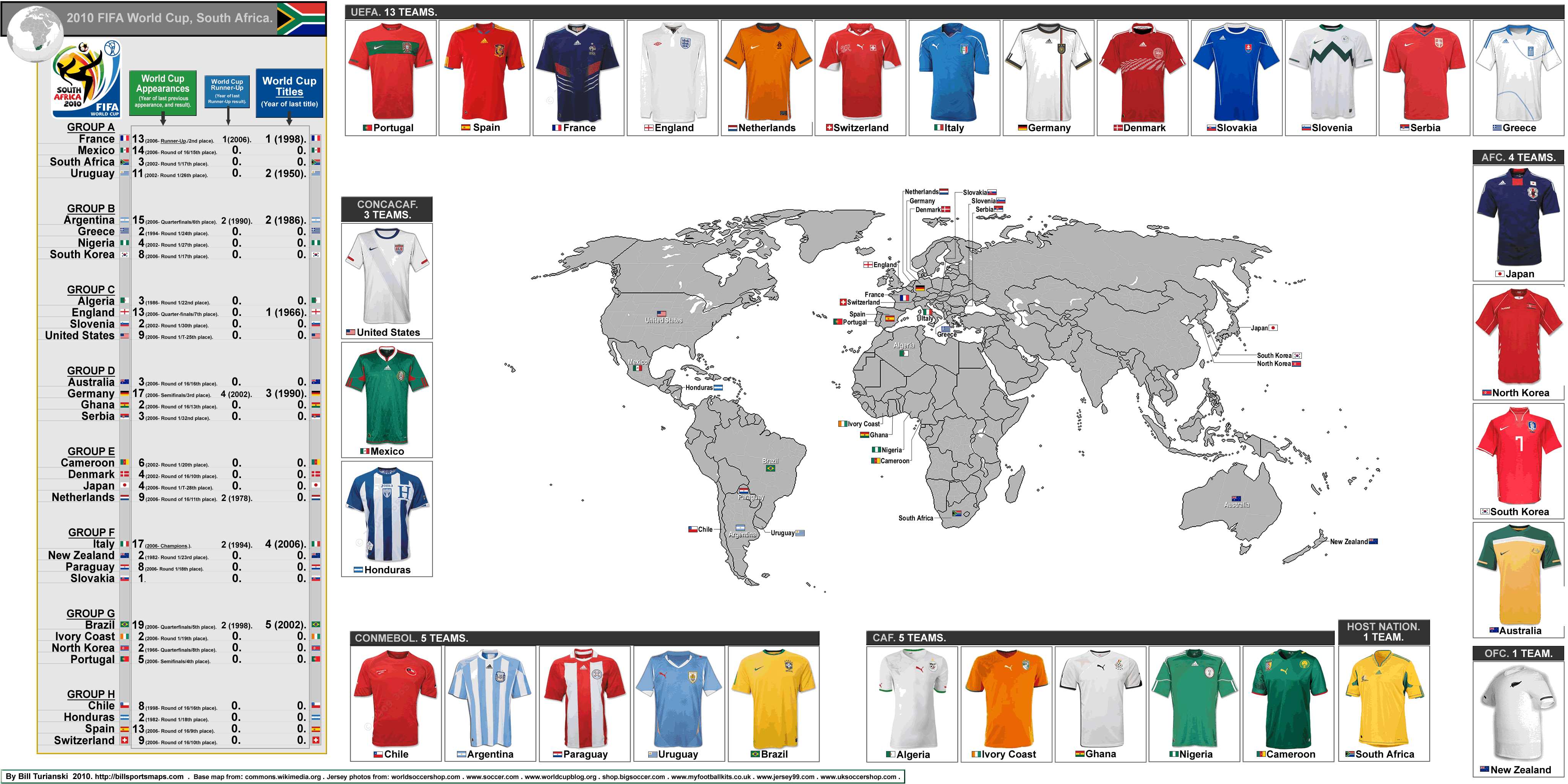
Review this map of the countries qualifying for this year's World Cup, and answer the questions below...


Have a better look at this map here.

Do you notice anything interesting about the distribution of teams in the World Cup this year? Think especially about economics and population, and how they relate to geography in this case.
  • Why do you think there are so many more European teams than any other continent?
  • How come the majority of the African teams qualifying are from a very close geographical area?
  • Do you think you have to know much about soccer to take a guess at these questions, or can you use historical, political, and social concepts to try and formulate and answer?

Remember your thoughts about these ideas when completing the activities below.

Tuesday, June 15, 2010

History and National Symbolism Activity

If you're not familiar with soccer logos, here's a quick intro... Teams generally wear a small crest on upper corner of their chest. See here:


A team's crest represents their respective nation or team. The United States, as you see above, has a pretty simple design. Stars and stripes (which we should be pretty well familiar with), and a simple US and soccer ball. Now, the blue stripes and red background for stars remains to be described. But the point is, the logo represents a meaningful reference for us as Americans. We see stars and stripes, red, white and blue on our national flag and in our patriotic songs.

Other countries throughout the world have a similar take on their national symbols and history. Check out the stories behind some of the crests for other national squads:


Cameroon, a sub-Saharan African nation, also uses a modified form of their flag in their crest, but also has a second symbol, of the "Indomitable Lion," partly to recognize the local wildlife, but also as a symbol of the team's success as Africa's most successful international team- qualifying for the World Cup more than any other country on the continent. The three vertical bands in the flag signify the "tricolor" flag of France (as a colonial ruler of Cameroon- French is still and official language), with red to indicate unity, yellow to show the sun and savannas in the north, and green for hope and the forests of the south. A central yellow star is called the "star of unity" (CIA World Factbook).
Check out this advertisement, briefly describing their look for this year's tournament:


Italy features a more historical twist to their crest. While once again, we see the use of the national flag, the team's primary color is not red, white, or green. It's actually "azure blue."


Why, you may ask... Prior to the 1860s, Italy was actually broken up into a series of separate kingdoms. Il Risogimento ("The Resurgence") began in the early 1860s, and consolidated power amongst the various Italian regions, all under the Kingdom of Italy. Throughout this time period (essentially through World War II), Italy was ruled by kings of the House of Savoy, who represented the unified nation under a flag featuring a shield depicting the signs of their monarchy, with "azzurro Savoia" (Savoy blue) encompassing the Savoy's shield:


And thus, the legend of the Azzurri (as is now the team nickname as well) was born.


Algeria's jersey crest, again based on their national flag, feature cultural as well as religious elements. The color scheme symbolizes Islam (green), purity and peace (white), and liberty (red). A crescent and star are also symbolic if Islam, with elongated "horns" of the crescent part of an Algerian belief that the longer horns bring happiness (CIA World Factbook).


For a few more examples, check out the stories behind England and the Netherlands by clicking the crests below:


Use the CIA Flags of the World page to see the role colors and symbols play in national flags. Do some investigating of your own- pick one or two countries that you have a personal interest in (whether in the soccer tournament or not) and comment on their flag's significance and symbology. Is there anything particularly meaningful you find?


Hopefully you have a pretty good idea of what types of symbolism goes into the design of a soccer crest. Think about these designs, and answer the following in post:
  • What is your opinion of the logos? How do they compare to you perception of each country before having learned a little about each?
  • How would you redesign any of the logos above, or a crest from another country, based on what you know about that country?
  • What about the United States? Would you want to see different symbols used to portray the US?


Now, to get an even better idea of this concept, design your own personal crest to describe yourself.
(we would maybe do this as a homework assignment or in class activity, but for the blog, just describe in a post what you might do if you were to actually create one)
  • What kinds of symbols or objects did you use, and what do they represent?
  • How about colors?
  • How does each element interact to create the whole image?
  • Think about how you chose to depict yourself, and add any comments.

Making Connections- Research Activity

(this is a pretty long activity- give it a glance over for now)

Take a look back at the country data by clicking the flags above, and using the links and videos found throughout the site, especially the CIA World Factbook, do some digging into the different connections that can be made regarding teams at the World Cup. You could consider one of the following topics, or come up with your own:

  • Survey the political representation of countries. There are probably many similar generic forms of government, but is there any specific form that dominates? Are there any correlations between governing style and geographic location?
  • Select a country (or a few countries) and look at potential connections between success of the teams (i.e. rankings or championships) and other factors present in a country, such as GDP, population, geographic location, demographics, historical factors, etc. Are there any relevant trends or themes? If yes, what may be the causes?
  • One of the storylines in South Africa is the historical context of teams involved in this year's World Cup. For instance, there are several connections that can be made between countries competing in terms of colonial relationships (i.e. England/USA, Portugal/Brazil), or political tensions (i.e. North Korea/South Korea). Use the Factbook, or other sources to describe this relationship, both in a historical sense, and also how the relationship between the countries exists today. Are the connections or hostilities still relevant? Has the relationship deterred or progressed over time? etc.
  • You can also address some of the questions and issues described earlier in the blog.

Share your findings in a post.

Finally:
  • Reflect on your thoughts about representation and the World Cup, both in the media and in the people and countries involved.
  • Do you buy into the political, cultural, and social storylines played up by the media? Are they even relevant? Do they have data to support their cause?
  • What types of influence do you believe the World Cup and soccer as an industry has on global culture?

Sharpen your skills-

Try your hand at naming the World Cup participants by their capitals: world cup capitals, or see if you can name every country in the world!
is a great site that has more fun & educational games


Test out that knowledge of world flags:


The Traveler IQ challenge ranks geographic knowledge of cities such as: San Francisco, Tallahassee or Oranjestad by comparing results against 5,633,091 other travelers. Brought to you by TravelPod, a TripAdvisor Media Network partner
How about more map games: travel iq- and an even better selection on facebook, or try a more simple geography game with audio resources


Or try Map Madness World Cup once again:


If you're feeling outgoing, post your scores to share with everyone!